
 04069063398
 Clinic Locator
Dengue Fever: Early Warning Signs You Should Never Ignore
Every monsoon, dengue makes its way through homes, cities, and entire neighbourhoods. It often starts off feeling like just another seasonal fever, which is why so many people wait before seeing a doctor. But dengue is not a wait-and-watch illness. About one in four people infected fall sick, and one in twenty develops a severe form that can turn dangerous within hours. The sooner you spot the signs, the safer you stay.
What Is Dengue Fever?
Dengue is a viral infection carried by the Aedes aegypti mosquito, and in some cases, the Aedes albopictus. These mosquitoes are small and black. They also have marks with white stripes on their legs. Aedes mosquitoes breed in clean, still water, such as the kind that collects in coolers, flower pots, or rooftop tanks. Unlike malaria mosquitoes, Aedes mosquitoes bite mostly during the day, with a strong preference for early morning and late afternoon.
The dengue virus has four different strains, known as DENV-1, DENV-2, DENV-3, and DENV-4. Once you recover from one strain, you are protected against that one for life. But you can still catch the other three. In fact, a second infection with a different strain is often more severe than the first².
What Are the Early Symptoms of Dengue?
Dengue symptoms usually appear four to ten days after an infected mosquito bite. In the first few days, dengue can feel quite similar to a viral flu, which is why it is easy to miss.
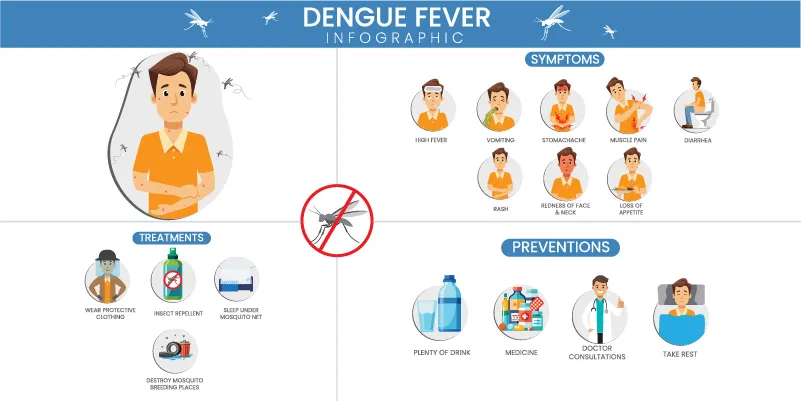
Common early signs include:
- A sudden high fever, often up to 104°F (40°C)
- A strong headache, usually across the forehead
- Pain behind the eyes that worsens with eye movement
- Severe muscle, joint, and bone pain, which gives dengue its older name, "breakbone fever"
- Nausea and vomiting
- Swollen lymph nodes in the neck
- A flat, red skin rash that appears two to five days after the fever begins
- Loss of appetite and a bitter taste in the mouth
Most people recover in about a week. But if you live in or have recently visited a dengue-prone area, do not dismiss a fever that lasts more than two days. A simple blood test can confirm the infection early.
What Are the Warning Signs of Severe Dengue?
Severe dengue is a medical emergency. It often appears 24 to 48 hours after the fever starts to drop, a phase doctors call the critical phase. This is when blood vessels can become leaky, platelet counts can fall, and internal bleeding can start. The tricky part is that people feel a little better at this stage and assume the worst is over.
Watch carefully for these warning signs:
| Category | Warning Signs |
|---|---|
| Internal Bleeding | Nose or gum bleeding Blood in vomit, urine, or stool Tiny red or purple spots on the skin Heavy or unusual menstrual bleeding |
| Plasma Leakage and Shock | Severe stomach pain Vomiting 3 or more times in 24 hours Cold, clammy, or pale skin Rapid or difficult breathing Sudden drop in urine output |
| Neurological and General | Extreme tiredness or restlessness Confusion or drowsiness Fainting or near-fainting |
If you notice any of these, go straight to an emergency room. Quick medical care during this window can be life-saving.
How Is Dengue Diagnosed and Treated?
If your doctor suspects dengue, the next step is usually a simple blood test. In the first five days of fever, the most common one is the NS1 antigen test, which picks up the virus directly. After day five, doctors switch to the IgM and IgG antibody tests to see how your body is responding to the infection. Alongside these, a complete blood count (CBC) is done to keep a close eye on your platelet count, haemoglobin, and haematocrit, all of which can shift quickly during dengue.
There is no specific antiviral medicine that targets the dengue virus. Your physician will provide supportive treatment to ease your symptoms and protect you from complications while your body fights the infection.
- Rest as much as you can. Skip work, screens, and chores. Your body is doing the heavy lifting.
- Sip fluids through the day. Water, oral rehydration solution, coconut water, fresh soups, and dal water all help.
- Take paracetamol for fever and body aches, in the dose your doctor suggests.
- Avoid aspirin and ibuprofen, as they can thin the blood and raise the risk of bleeding.
- Get your platelet count checked regularly, just to be sure things are on track.
- Head to the hospital straight away if any warning signs show up, as severe dengue needs IV fluids and round-the-clock care.
Most people recover safely at home with steady rest, fluids, and gentle care. A small number may need a short hospital stay to manage their fluid levels and platelet count, and even then, the outlook is usually very positive with timely treatment.
How Can You Prevent Dengue?
Since a dengue vaccine is not yet widely available in India, prevention rests on two things: avoiding mosquito bites and clearing out places where they breed.
- Empty water from coolers, flower pots, buckets, and rooftop tanks once a week.
- Cover stored water tightly.
- Use mosquito repellents with DEET, picaridin, or oil of lemon eucalyptus.
- Sleep under a mosquito net, even during the day.
- Wear long sleeves and full-length trousers.
- Install mesh screens on doors and windows.
- Clear rubbish and unclog drains around your home.
Seek Timely Care for Dengue at Apollo Clinic!
Dengue can feel frightening, especially when the fever refuses to settle, and worry begins to creep in. The good news is that with timely care and a little caution, most people recover completely and bounce back to their usual routine. The most important thing is not to wait it out at home if a fever lingers beyond two days, particularly during the monsoon.
Walk into your nearest Apollo Clinic for a quick consultation, a timely dengue test, and close monitoring of your platelet count. Our doctors will sit with you, explain each step gently, and stay with you all the way through, from your very first blood test to a full and steady recovery.
FAQs
1. Can dengue come back after I have recovered?
Yes, it can. The dengue virus has four different strains, so even if you have already had it once, you can still catch it again from another strain. What is worth knowing is that a second bout often turns out to be more serious than the first, which is why prevention stays important even after recovery.
2. Why does the platelet count drop in dengue?
The dengue virus slows down the bone marrow, the place where new platelets are made, and also damages the platelets already in your blood. This is why your doctor checks your platelet count daily during the illness, just to make sure it does not fall to a worrying level.
3. When is the best time to get tested for dengue?
If you have a fever in the first five days, your physician will suggest an NS1 antigen test. After day five, you will be asked to check for the IgM and IgG antibody tests, which can confirm whether your body is actively fighting the dengue virus.
4. Can a person get dengue and malaria at the same time?
Yes, though it is not very common. The two problems share some symptoms, like high fever and body aches, which can make them tricky to identify. If your symptoms feel unusually severe or confusing, your physician will test you for both at the same time.
5. When is it safe to go back to work after dengue?
Most people need about two weeks before they truly feel like themselves again. Try not to rush back. Wait until your platelet count is normal, your energy has returned, and your doctor gives you the green light. Pushing yourself too soon can leave you feeling drained for weeks afterwards.