
 04069063398
 Clinic Locator
How to Spot Skin Cancer Early: Warning Signs You Shouldn't Ignore
A new mole or unusual skin spot can be easy to dismiss as a normal part of ageing or sun exposure. However, a spot that changes in size, shape or colour, continues to grow or fails to heal can be a sign of skin cancer and should not be ignored. Being aware of these changes can encourage timely evaluation and when needed, treatment, which helps ensure the best possible outcomes. In this blog, we’ll walk you through the warning signs of skin cancer that should not be ignored, along with how suspicious skin changes are evaluated and when to consult a dermatologist.
What is Skin Cancer?
Skin cancer develops when abnormal skin cells grow in an uncontrolled way. It can occur on any part of the body, including areas that receive little or no sun exposure.
The main types of skin cancer include:
- Basal cell carcinoma: Usually develops in areas exposed to the sun and may appear as a shiny bump, sore or other unusual skin growth.
- Squamous cell carcinoma: May appear as a rough or scaly patch, raised growth or sore that does not heal.
- Melanoma: Develops from pigment-producing cells and may appear as a new or changing mole or spot.
Skin cancer does not always have the same appearance. This makes it important to pay attention to new or changing areas of skin.
Warning Signs of Skin Cancer
Knowing the warning signs of skin cancer can help individuals recognize changes that require evaluation by a dermatologist.
A New or Changing Spot
A new spot or growth on the skin can be a warning sign, especially if it continues to grow or changes in size, shape or color. A spot that looks noticeably different from other marks on the skin also deserves attention.
Changes in an Existing Mole
Changes in an existing mole can include changes in its size, shape, color or texture. Irregular borders, uneven coloring or a noticeable change over time may require evaluation by a dermatologist.
A Sore That Does Not Heal
A sore or wound that does not heal after several weeks should not be ignored. A sore that heals but repeatedly returns, bleeds, oozes or develops a crust also needs attention.
Rough or Scaly Skin
A persistent rough or scaly patch can be a warning sign, particularly when it becomes crusted or bleeds.
A Wart-Like Growth
Some skin cancers can appear as wart-like growths. A new growth that continues to change or does not go away should be evaluated by a dermatologist.
Persistent Itching, Pain or Tenderness
Some suspicious skin lesions may cause persistent itching, pain or tenderness. These symptoms alone do not mean that a lesion is cancerous, but a persistent or unusual skin change should be checked.
The ABCDE Rule for Checking Moles
The ABCDE rule can help individuals recognize some common warning signs of melanoma. It is a guide, not a way to diagnose skin cancer.
- A – Asymmetry: One half of the mole does not match the other.
- B – Border: The edges are irregular, ragged, notched or blurred.
- C – Color: The mole has uneven coloring or contains different shades.
- D – Diameter: The spot is larger than about 6 millimeters, roughly the size of a pencil eraser. However, melanoma can also be smaller.
- E – Evolving: The mole changes in size, shape or color over time.
A new spot or one that is changing should be evaluated even if it does not show all of these features.
Risk Factors for Skin Cancer
Several factors can increase the risk of developing skin cancer. These include:
- Frequent or prolonged exposure to ultraviolet (UV) radiation from sunlight
- Use of tanning beds
- A history of sunburn
- Having many moles or atypical moles
- A personal or family history of skin cancer
- A weakened immune system
- Certain inherited conditions that increase skin cancer risk
Having a risk factor does not mean that an individual will develop skin cancer. People with a higher risk should discuss regular skin checks with a dermatologist rather than making assumptions based on their risk factors alone.
When Should You See a Dermatologist?
Self-checks can help individuals notice changes in their skin, but they cannot confirm whether a skin lesion is cancerous. Therefore, Individuals should schedule a dermatology evaluation if they notice:
- A new or changing mole, spot or growth
- A lesion that continues to grow
- An irregularly shaped or unevenly colored mole
- A sore that does not heal or repeatedly returns
- Persistent crusting, bleeding or oozing
- A rough or scaly patch that does not improve
- A skin lesion that remains itchy, painful or tender
A dermatologist can examine the affected area and determine whether further testing is needed. Many skin changes are caused by conditions other than cancer, so an unusual spot does not automatically mean skin cancer.
Diagnosis of Skin Cancer
A dermatologist begins by examining the suspicious area and asking when it first appeared and whether it has changed. The evaluation may also include questions about sun exposure, previous skin problems, and personal or family history of skin cancer.
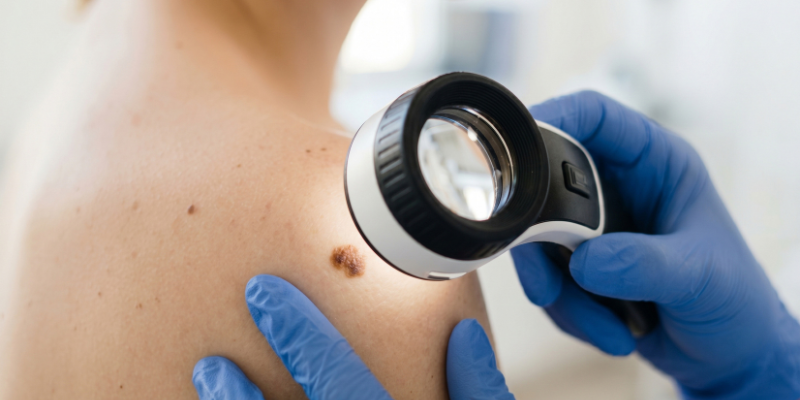
Depending on the appearance of the lesion, the dermatologist may use dermoscopy to examine the skin more closely. If the area appears suspicious, the dermatologist may recommend a skin biopsy. The collected tissue is examined to determine whether cancer cells are present.
Treatment for Skin Cancer
Treatment depends on the type of skin cancer, its size and location, and how far it has developed. A dermatologist or cancer specialist may recommend one or more of the following treatments:
- Surgical removal: The surgeon removes the cancerous tissue along with some surrounding healthy tissue to help ensure that the cancer cells are completely removed. Different surgical techniques may be used depending on the location and type of skin cancer.
- Cryotherapy: This treatment uses extreme cold, usually liquid nitrogen, to destroy selected abnormal or cancerous skin cells. It may be used for certain superficial skin cancers or precancerous lesions.
- Prescription topical medicines: Certain medicines can be applied directly to the skin to treat some early or superficial skin cancers. The medicine works on abnormal cells in the treated area.
- Radiation therapy: Radiation uses high-energy beams to destroy cancer cells. It may be considered when surgery is not suitable or when the cancer requires additional treatment.
- Other treatments: Advanced or specific types of skin cancer may require treatments such as immunotherapy, targeted therapy or other systemic medicines. The choice depends on the type and stage of cancer and the individual's overall condition.
Early evaluation allows the dermatologist to identify the condition and determine whether further testing or treatment is needed. Starting appropriate treatment early may also help manage skin cancer before it becomes more advanced.
How to Reduce the Risk of Skin Cancer
Not all cases of skin cancer can be prevented, but reducing UV exposure can lower the risk. Individuals can:
- Limit prolonged exposure to direct sunlight
- Use broad-spectrum sunscreen as directed
- Wear protective clothing and a wide-brimmed hat when spending time outdoors
- Seek shade when UV exposure is high
- Avoid tanning beds
- Check the skin regularly for new or changing spots
Regular skin checks can help individuals become familiar with their normal moles, marks and other skin changes, making it easier to notice something new or different.
Dermatology Care at Apollo Clinic
At Apollo Clinic, our dermatologists are experienced in evaluating a wide range of skin concerns, including skin cancer. They assess new, changing or unusual skin lesions and determine whether further evaluation or treatment is needed. Our centres also have advanced technology and infrastructure that complement the expertise of our dermatologists and support the evaluation and management of skin conditions, including skin cancer. To book a consultation, call 04069063398 or book an online appointment.
Frequently Asked Questions
What are the early signs of skin cancer?
Early signs may include a new or changing mole, spot or growth, a sore that does not heal, or a persistent rough or scaly patch. Changes in size, shape, color, bleeding, crusting or other unusual changes should be evaluated by a dermatologist.
What do early-stage skin cancer spots look like?
The appearance varies by type. A skin cancer spot may look like a changing mole, an irregularly colored patch, a rough or scaly area, a shiny bump or a sore that does not heal. Skin cancer does not have one typical appearance.
How can you identify skin cancer?
A skin lesion cannot be confirmed as cancerous by appearance alone. Dermatologists examine the lesion and may use dermoscopy for a closer assessment. If needed, they can also recommend a skin biopsy to confirm the diagnosis by examining a tissue sample under a microscope.
Are all black spots on the skin cancerous?
No. Dark spots can have many causes, including harmless moles, freckles, age spots and other skin conditions. A dermatologist should evaluate a spot that is new, changing, irregular or otherwise unusual.
How can you tell an age spot from skin cancer?
Age spots are usually flat, well-defined areas of increased pigmentation that remain relatively stable. Skin cancer may change in size, shape or colour, or develop irregular borders, bleeding, crusting or other unusual features. A dermatologist can assess a spot when its appearance is uncertain.
Can skin cancer look like a normal mole?
Yes. Melanoma can sometimes resemble a normal mole, particularly in its early stages. A mole that changes in size, shape or colour, develops irregular borders or looks different from other moles should be examined by a dermatologist.
When should you see a dermatologist about a skin spot?
Individuals should consult a dermatologist if a spot is new, changes over time, continues to grow, develops irregular borders or uneven colour, repeatedly bleeds or crusts, or does not heal. At Apollo Clinic, we have a team of experienced dermatologists, advanced diagnostic facilities and infrastructure. Our dermatologists use these facilities to evaluate concerning skin changes and develop a personalised treatment plan based on their findings.